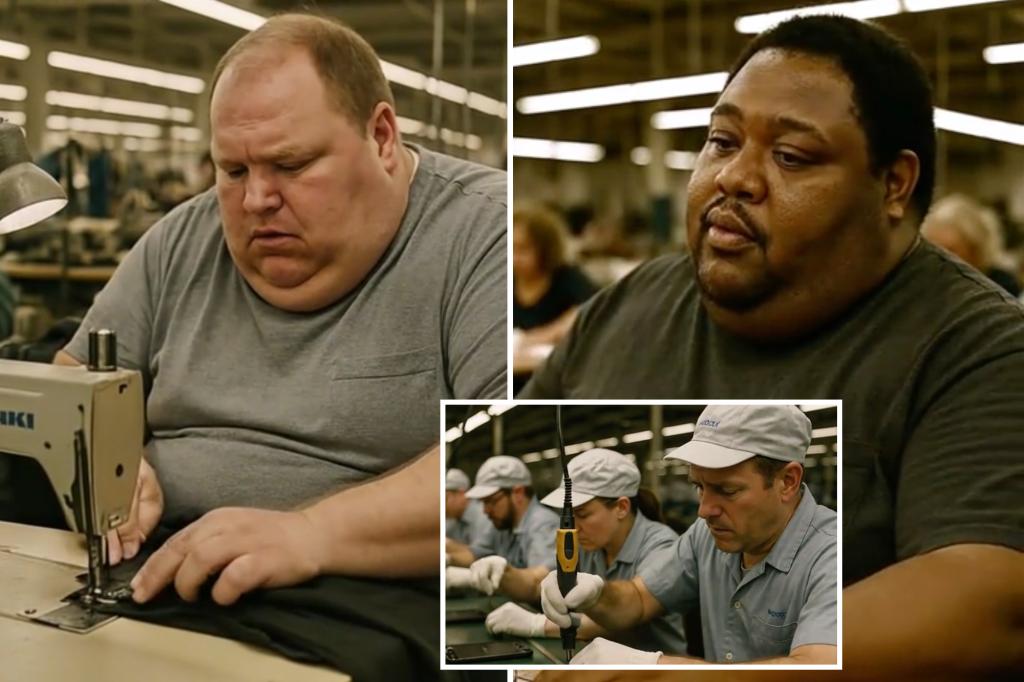
The Future of American Manufacturing: AI Satire Sparks Debate on Trump’s Tariff Promises
A viral AI-generated satire video mocking the idea of Americans returning to factory jobs has ignited discussions about former President Donald Trump’s renewed pledge to revive U.S. manufacturing through aggressive tariffs. The juxtaposition highlights tensions between nostalgic industrial policies and the realities of automation, raising critical questions about the future of work in America.
The Viral Satire That Captured a Policy Paradox
The two-minute video, created by an anonymous AI artist, depicts a futuristic factory where robotic arms assemble products while a lone human worker stares blankly at a control panel labeled “Make America Great Again.” The clip, viewed over 5 million times since its June 2024 release, coincidentally emerged as Trump promised 60% tariffs on Chinese imports during campaign rallies.
“The video resonates because it exposes the cognitive dissonance in our manufacturing nostalgia,” said Dr. Elena Rodriguez, a labor economist at MIT. “We’re trying to solve 21st-century problems with 20th-century solutions. Even if tariffs bring factories back, those facilities won’t employ masses of workers like they did in 1970.”
Key statistics underscore this shift:
- U.S. manufacturing output hit record highs in 2023 despite employing 30% fewer workers than in 2000
- Automation has eliminated 1.7 million factory jobs since 2000 while creating just 400,000 new tech-related positions
- Only 8% of current U.S. manufacturing jobs involve traditional assembly line work
Trump’s Tariff Vision vs. Automation Realities
The former president’s proposed tariffs—60% on Chinese goods and 10% universal baseline tariffs—aim to incentivize domestic production. However, economists note that modern reshoring typically involves highly automated facilities. When Taiwanese semiconductor giant TSMC opened its $40 billion Arizona plants in 2024, it created just 4,500 jobs despite being the largest foreign investment in U.S. history.
“Tariffs might change where things get made, but not how they get made,” explained manufacturing consultant James Whitmore. “A U.S.-built electric vehicle factory today employs 30% fewer workers than a 1990s GM plant making the same number of cars.”
Proponents argue tariffs could still benefit American workers:
- Increased domestic production might create supporting service jobs
- Some labor-intensive industries like textiles could see limited job growth
- Strategic sectors like chip manufacturing gain geopolitical security
The Skills Gap Challenge
Even if manufacturing jobs return, the U.S. faces a critical skills mismatch. The National Association of Manufacturers reports 800,000 current job openings requiring advanced technical skills but insufficient qualified applicants. Community college programs in mechatronics and industrial robotics often have waitlists exceeding two years.
“We’re preparing workers for the factories of 1985, not 2030,” said Diane Kowalski, a workforce development specialist in Ohio. “The good-paying jobs now require programming collaborative robots, not tightening bolts.”
Meanwhile, the satire video’s creator (who goes by @FactoryAI online) told followers: “My point wasn’t that manufacturing is dead—it’s that we need to stop lying to workers about what revival actually means.”
Global Perspectives on Industrial Policy
Other nations face similar dilemmas but approach them differently:
- Germany combines tariffs with robust vocational training in Industry 4.0 technologies
- South Korea subsidizes automation adoption while taxing robots to fund worker retraining
- China maintains labor-intensive export sectors while dominating EV and solar panel production
These models suggest that successful industrial policy requires more than just trade barriers. As automation accelerates—global industrial robot installations grew 12% annually since 2020—the very definition of “manufacturing job” continues evolving.
Pathways Forward for U.S. Industrial Policy
Experts propose several approaches to reconcile tariff policies with technological realities:
- Robot taxes: Levy fees on automation to fund universal basic income or retraining
- Productivity tariffs: Adjust import taxes based on foreign factories’ automation levels
- Microfactories: Support small-batch, artisanal manufacturing through tax incentives
The Biden administration has quietly piloted some alternatives, including $1.2 billion in grants for “human-centric automation” projects that combine AI with skilled workers. Early results from Michigan pilot sites show 15% higher productivity than fully robotic lines.
Conclusion: Beyond Nostalgia to Next-Generation Manufacturing
The viral satire video and Trump’s tariff promises reveal a fundamental tension in American economic policy. While political rhetoric often invokes images of bustling mid-century factories, the future likely involves hybrid workplaces where humans supervise AI systems, repair advanced machinery, and design products for automated production.
“The question isn’t whether tariffs will bring jobs back,” concluded Dr. Rodriguez. “It’s whether we’re preparing Americans for the jobs that will actually exist.” As the 2024 election approaches, voters face a choice between competing visions of industrial revival—one rooted in the past, the other grappling with an automated future.
What’s your vision for American manufacturing? Share your perspective with local representatives and join the conversation about preparing workers for tomorrow’s economy.
See more CCTV News Daily