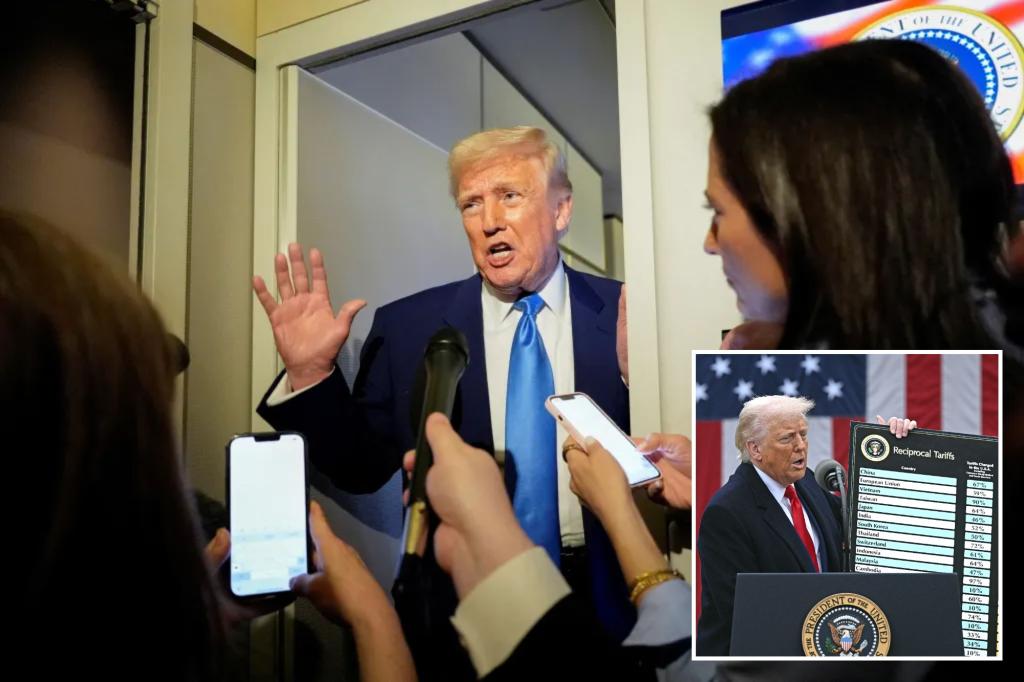
Trump’s Bold Tariff Strategy: A ‘Beautiful’ Gamble Amidst Market Turmoil
As stock futures plummet amid economic uncertainty, former President Donald Trump doubled down on his signature tariff policies, calling them a “beautiful thing to behold.” The Republican leader’s unwavering support for aggressive trade measures comes despite warnings from economists and market analysts that such strategies could exacerbate inflation and strain global relations. With the 2024 election looming, Trump’s tariff stance is shaping up as both a political weapon and an economic gamble.
The Anatomy of Trump’s Tariff Vision
Trump’s trade philosophy centers on using tariffs as both economic leverage and political messaging. During his presidency, he imposed:
- 25% tariffs on $50 billion worth of Chinese goods in 2018
- Steel and aluminum tariffs affecting allies like Canada and the EU
- Section 301 tariffs covering approximately $370 billion in Chinese imports
“Tariffs are the greatest negotiating tool ever invented,” Trump declared at a recent rally, framing them as protection for American workers. However, data from the Tax Foundation suggests his first-round tariffs reduced long-term GDP by 0.21% and wages by 0.14%.
Market Reactions and Economic Fallout
The Dow Jones Industrial Average futures dropped 400 points following Trump’s latest tariff remarks, reflecting investor anxiety. “Markets abhor uncertainty, and blanket tariff threats create exactly that,” explains Dr. Lila Chen, Chief Economist at the Global Policy Institute. “While targeted tariffs can sometimes achieve strategic goals, across-the-board approaches often trigger retaliatory cycles that hurt consumers.”
Key economic indicators under scrutiny include:
- Consumer Price Index (up 3.4% year-over-year as of May 2024)
- Import price inflation (2.6% monthly increase in April)
- Manufacturing PMI (contracted for 7 of past 12 months)
Global Trade Relations at a Crossroads
International leaders are watching Trump’s tariff rhetoric warily. The European Commission recently warned of “proportionate countermeasures” should new tariffs emerge. Meanwhile, China’s Commerce Ministry stated it would “defend its legitimate rights” through WTO mechanisms.
“Trade wars aren’t easily contained,” notes former U.S. Trade Representative Carla Hills. “When major economies clash on tariffs, smaller nations get caught in the crossfire, and global supply chains fracture.” The Peterson Institute estimates Trump’s previous tariffs cost the average American household $1,277 annually in higher prices and tax burdens.
Political Calculus Behind the Tariff Push
Trump’s tariff advocacy serves multiple political purposes:
- Appeals to blue-collar voters in swing states
- Differentiates his “America First” platform from Biden’s approach
- Simplifies complex trade issues into populist messaging
“There’s a visceral appeal to promising factory jobs will return through tough trade policies,” observes political strategist Marcus DeWitt. “The challenge is that modern manufacturing often involves automation rather than mass employment, regardless of tariffs.”
Alternative Approaches to Trade Policy
Some economists advocate for more nuanced strategies than blanket tariffs:
- Targeted subsidies for critical industries
- Multilateral trade agreements with allies
- Investment in workforce retraining programs
“The solution isn’t abandoning trade tools, but using them surgically,” suggests Brookings Institution fellow Dr. Amanda Zhou. Her research indicates sector-specific tariffs paired with domestic incentives can be 37% more effective than broad tariffs at achieving policy goals without market disruption.
What Comes Next for Trade Policy?
As the election approaches, expect tariffs to remain a flashpoint. The Biden administration recently increased some tariffs on Chinese EVs and semiconductors while maintaining most Trump-era levies—a hybrid approach reflecting trade policy’s complexities.
Market analysts advise businesses to:
- Diversify supply chains beyond single countries
- Increase inventory buffers for critical components
- Model multiple tariff scenarios in financial planning
Whether Trump’s tariff vision proves “beautiful” or burdensome may depend on execution details still unseen. What’s certain is that in an interconnected global economy, trade policy reverberates far beyond political soundbites. For investors and policymakers alike, the coming months demand careful analysis of how rhetoric translates to reality.
Stay informed on evolving trade policies by subscribing to our economic policy newsletter for weekly expert analysis.
See more CCTV News Daily