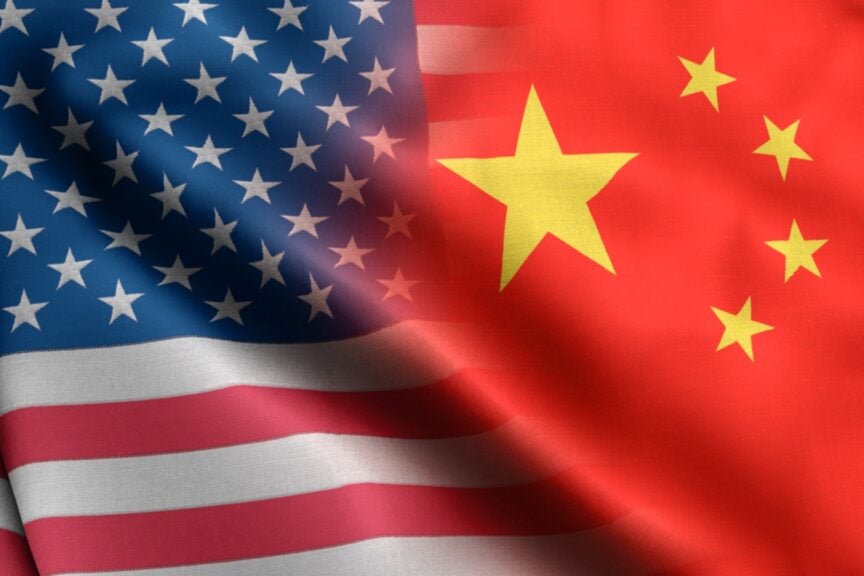
China Stands Firm Against Trump’s Tariff Threat in Escalating Trade War
China has pledged to retaliate with “resolute measures” against former U.S. President Donald Trump’s proposal to impose 50% tariffs on Chinese imports if re-elected. The brewing economic confrontation, emerging in early 2024 campaign rhetoric, threatens to destabilize global markets and reignite the trade war that cost both nations billions during Trump’s first term.
The Looming Tariff Battle: What’s at Stake
Trump’s campaign trail remarks about imposing across-the-board 50% tariffs—a significant escalation from his previous 25% tariffs on $250 billion of Chinese goods—have sent shockwaves through international markets. Analysts at Morgan Stanley estimate such measures could:
- Reduce China’s GDP growth by up to 1.5 percentage points annually
- Increase U.S. consumer prices by 3-5% on affected goods
- Disrupt $650 billion in annual bilateral trade
“This isn’t just posturing—we’re looking at potential supply chain Armageddon,” warns Dr. Evelyn Tan, senior fellow at the Peterson Institute for International Economics. “The 2018-2020 trade war reduced U.S. manufacturing employment by 0.4%. At 50% tariffs, we could see triple that impact.”
China’s Strategic Countermeasures
Beijing’s Commerce Ministry spokesperson Mao Ning stated China would “defend its legitimate rights and interests through all necessary means,” signaling potential responses including:
- Targeted tariffs on U.S. agricultural exports
- Export restrictions on rare earth minerals
- Accelerated decoupling from dollar-denominated trade
Data from China’s Customs Administration reveals the nation has diversified trade partners since 2020, with ASEAN countries now receiving 15.8% of Chinese exports compared to 12.9% for the U.S. “We’ve spent four years building alternatives,” said Professor Chen Wei of Peking University. “If Washington slams doors, we’ll redirect trade through the RCEP framework and Belt & Road Initiative.”
Global Economic Ripple Effects
The potential conflict arrives as the World Bank projects fragile 2.4% global growth for 2024. Emerging markets particularly vulnerable to trade disruptions include:
- Vietnam (22% of GDP tied to China-U.S. supply chains)
- Mexico (18% export exposure)
- Germany (9% industrial output dependent on Sino-American trade)
“This isn’t a bilateral issue anymore,” notes IMF Managing Director Kristalina Georgieva. “When elephants fight, the grass suffers. We’re urging both parties to consider multilateral solutions through WTO frameworks.”
Industry-Specific Impacts Coming Into Focus
Sector analysis reveals disproportionate risks:
Technology and Manufacturing
The semiconductor industry, already reeling from export controls, could face 30-40% cost increases on chip manufacturing equipment if tariffs encompass ASML and Applied Materials products.
Agriculture
U.S. soybean farmers, who exported $14.2 billion to China in 2023, fear a repeat of 2018’s 75% drop in Chinese purchases during the last trade war.
Consumer Goods
Retail analysts project Walmart and Target could see 8-12% price hikes on electronics, apparel, and home goods if tariffs take effect.
Historical Precedents and New Realities
The 2018-2020 trade war provides sobering lessons:
- U.S. GDP lost $316 billion (Congressional Budget Office)
- China’s exports to America fell 12.5% in 2019
- Both nations ultimately signed Phase One deal in January 2020
However, current circumstances differ significantly. “China’s domestic consumption now drives 60% of growth versus 42% in 2018,” notes HSBC Asia economist Jingyang Chen. “They’re better insulated but face property sector crises that complicate responses.”
Pathways Forward: Diplomacy or Escalation?
Potential scenarios include:
- Negotiated Solution: Revival of bilateral working groups to address trade imbalances
- Targeted Tariffs: Sector-specific measures rather than blanket 50% rates
- Full Trade War: Mutual decoupling with lasting global consequences
As Stanford economist Michael Boskin observes, “The economic equivalent of mutually assured destruction still applies. Both sides have tools to inflict pain, but wisdom lies in finding off-ramps before container ships start changing course.”
The Long Game: Reshaping Global Trade Architecture
Beyond immediate tariffs, this confrontation accelerates structural shifts:
- China’s yuan settlement share in trade rose to 24% in 2023 from 15% in 2018
- U.S. nearshoring to Mexico hit record $34 billion in Q1 2024
- ASEAN’s manufacturing PMI consistently outperforms China since 2022
The coming months will test whether economic interdependence remains a stabilizing force or gives way to nationalist policies. For businesses and investors, scenario planning has become imperative—monitor official statements from both capitals while diversifying supply chains where possible.
Stay informed on evolving trade policies by subscribing to our global markets newsletter for weekly expert analysis.
See more CCTV News Daily