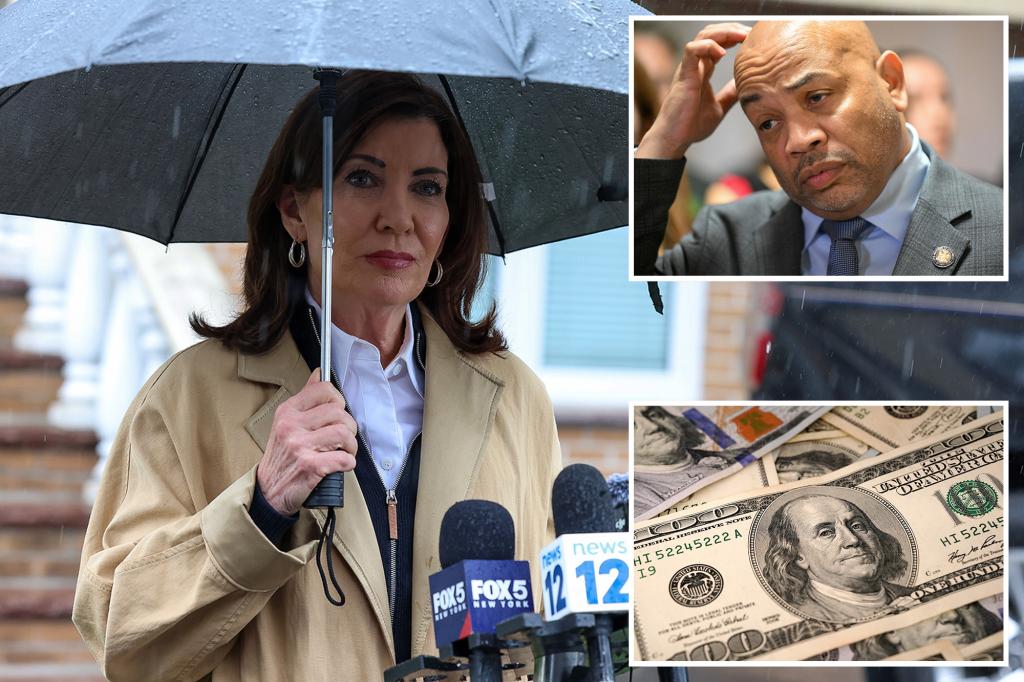
New York’s Bold Budget Move: Governor Hochul Taps Reserves to Tackle $7 Billion Unemployment Debt
In a dramatic fiscal intervention, New York Governor Kathy Hochul revealed plans to deploy state reserve funds to eliminate a crippling $7 billion unemployment insurance debt accumulated during the pandemic. The unexpected announcement, made during budget negotiations this week, aims to shield businesses from massive tax hikes while stabilizing the state’s post-COVID economy. Officials project this strategic maneuver could save employers approximately $800 million annually through 2025.
The Debt Crisis That Forced Hochul’s Hand
New York’s unemployment insurance trust fund collapsed under the weight of pandemic-era claims, peaking at 1.8 million weekly filings in May 2020. The state borrowed $9.3 billion from the federal government to keep benefits flowing—the second-highest COVID-related unemployment debt in the nation. While 22 states have fully repaid their advances, New York’s remaining $7 billion balance threatened to trigger:
- Automatic employer tax increases of up to 30% starting 2024
- Reduced unemployment benefits for workers
- A competitive disadvantage versus neighboring states
“This isn’t just accounting—it’s economic triage,” stated Manhattan Institute economist Raymond Wong. “Without intervention, we’d see job growth stagnate as businesses shoulder what amounts to a pandemic penalty.”
How the Reserve Fund Strategy Works
Hochul’s plan redirects $7 billion from New York’s $19.5 billion reserve funds—a stockpile bolstered by stronger-than-expected tax revenues and federal stimulus money. The approach mirrors California’s 2021 debt payoff but dwarfs it in scale. Key components include:
- Immediate debt retirement: Full repayment to the U.S. Treasury by Q1 2024
- Business tax relief: Freezing unemployment tax rates at 2023 levels
- Future safeguards: $1 billion contingency for economic downturns
Labor advocates cautiously praised the move. “Workers shouldn’t bear the brunt of a systemic crisis,” said AFL-CIO NY President Mario Cilento. “But we need guarantees that benefit accessibility won’t erode during the next recession.”
Mixed Reactions From Business and Policy Circles
The Partnership for New York City called the decision “a lifeline for small businesses still recovering from lockdowns.” Restaurant owner Elena Torres testified that anticipated tax hikes would have forced layoffs at her three Brooklyn eateries. “This gives us breathing room to rebuild,” she said.
However, fiscal conservatives warn about depleting reserves. “Rainy day funds exist for emergencies—not to clean up policy failures,” argued Empire Center analyst Peter Warren. “New York still hasn’t addressed structural issues that made our unemployment system so vulnerable.”
Data reveals troubling context: New York’s average unemployment trust fund solvency ratio ranked 48th nationally pre-pandemic, with only 0.3% of taxable wages covered—far below the U.S. Department of Labor’s recommended 1.0% minimum.
Long-Term Implications for New York’s Economy
The debt clearance removes a significant barrier to business growth, particularly for labor-intensive industries. A 2022 Federal Reserve study showed states that repaid unemployment debts early saw 2.1% faster job growth than those that didn’t. Potential ripple effects include:
- Attracting out-of-state employers deterred by high UI taxes
- Preserving approximately 45,000 jobs at risk from tax hikes
- Freeing capital for wage increases and expansion
Yet challenges remain. The state must rebuild reserves while addressing a projected $6.2 billion budget gap in 2025. Hochul’s administration promises reforms to prevent future crises, including modernizing claim systems and adjusting employer contribution formulas.
What Comes Next for Unemployment Policy
With the immediate crisis addressed, attention turns to systemic fixes. Policy experts recommend:
- Implementing automatic solvency triggers to replenish funds
- Expanding short-term compensation programs to avoid layoffs
- Increasing fraud prevention after $11 billion in pandemic overpayments
“This is a short-term win that demands long-term discipline,” cautioned former State Budget Director Robert Mujica. “The real test is whether we learn from history or repeat it.”
As businesses digest the news, many are cautiously optimistic. For workers and employers alike, New York’s bold budget move could mark a turning point—if accompanied by prudent reforms. Those impacted can track implementation progress through the state’s Unemployment Insurance Reform Portal launching next month.
See more CCTV News Daily