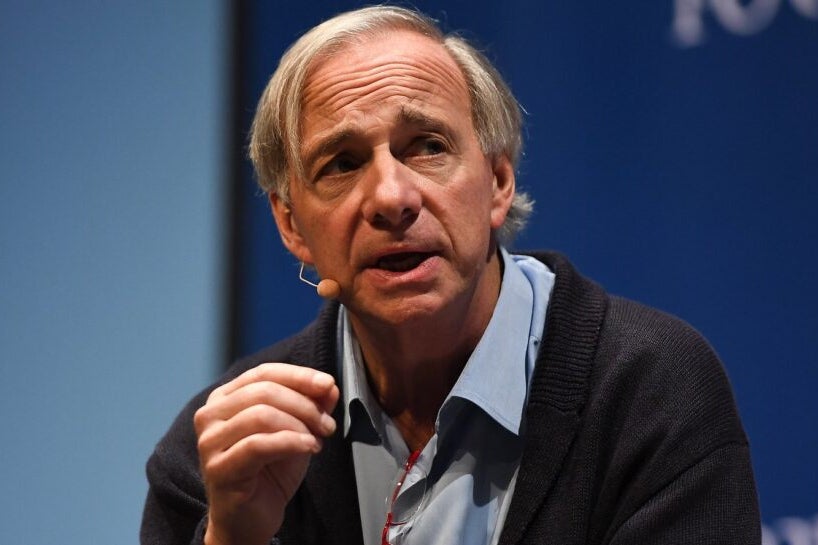
Economic Oracle Ray Dalio Sounds Alarm on Recession Risks Amid US-China Trade War
Renowned investor Ray Dalio, founder of Bridgewater Associates, has issued a stark warning about an impending U.S. recession fueled by escalating trade tensions between Washington and Beijing. The billionaire hedge fund manager, who predicted the 2008 financial crisis, cites deteriorating economic indicators and retaliatory tariffs as creating a perfect storm for global markets. His analysis comes as both nations implement fresh trade restrictions, with economists estimating the conflict could shave 0.5-1.2% off global GDP growth in 2024.
The Perfect Economic Storm: Trade Wars Meet Financial Pressures
Dalio’s recession forecast stems from multiple converging factors that mirror pre-crisis patterns. The U.S. recently announced 25% tariffs on $18 billion worth of Chinese imports, targeting electric vehicles, steel, and semiconductors. China responded by restricting critical mineral exports, escalating a conflict that began in 2018 under the Trump administration.
“We’re seeing classic late-cycle dynamics,” Dalio stated in a recent investor note. “When you combine structural trade imbalances with tightening credit conditions and geopolitical friction, the math points toward contraction.” Key warning signs include:
- Inverted yield curve persisting for 16 months (historically 85% accurate in predicting recessions)
- Global trade volume growth slowing to 1.7% in Q1 2024, down from 3.4% in 2023
- U.S. manufacturing PMI contracting for 14 of the last 16 months
Supply Chain Fallout and Inflationary Pressures
The renewed trade war is disrupting carefully rebuilt supply chains, with 68% of multinational corporations reporting increased logistics costs according to a Gartner survey. Automotive and technology sectors face particular strain, as both nations dominate critical production nodes.
“This isn’t 2018 anymore,” explains Dr. Lina Wong, senior fellow at the Peterson Institute for International Economics. “Companies exhausted their contingency plans during COVID. There’s no inventory buffer left, meaning price spikes will hit consumers faster and harder.”
Recent data supports this assessment:
- Container shipping rates from Asia to U.S. West Coast up 217% year-over-year
- Lead times for industrial electronics extending to 26 weeks, double pre-pandemic averages
- Federal Reserve’s preferred inflation gauge rising to 3.2% in May, reversing earlier progress
Diverging Expert Views on Recession Probability
While Dalio’s warning carries weight, not all analysts share his dire assessment. Treasury Secretary Janet Yellen recently stated the U.S. economy remains “resilient,” pointing to:
- Unemployment holding at 3.9%
- Q1 GDP growth of 1.4% (annualized)
- Consumer spending increasing 2.5% year-over-year
However, regional Fed surveys reveal cracks beneath the surface. The Philadelphia Fed’s manufacturing index plunged to -13.5 in June, its lowest reading since the pandemic. Meanwhile, credit card delinquencies surpassed pre-COVID levels, suggesting household financial strain.
The China Factor: Beyond Tariffs
Dalio emphasizes that the current conflict extends far beyond traditional trade measures. “We’re witnessing economic decoupling in real time,” he notes, referencing:
- U.S. outbound investment restrictions in sensitive technologies
- China’s “dual circulation” strategy reducing import dependence
- Both nations building parallel financial systems (SWIFT alternatives, digital currencies)
This structural separation could have lasting consequences. A McKinsey analysis estimates complete tech sector decoupling might cost $3-5 trillion in global GDP over five years. Semiconductor firms already report 18% reduced R&D spending due to market fragmentation.
Potential Pathways Forward
Economists suggest three possible scenarios for the coming year:
- Negotiated Ceasefire (25% probability): Both sides freeze new tariffs while maintaining existing measures
- Managed Escalation (55% probability): Targeted restrictions continue without full-blown trade war
- Full Economic Conflict (20% probability): Broad sanctions resembling U.S.-Russia dynamics
Market strategists recommend defensive positioning. “Investors should prioritize quality balance sheets and domestic-focused companies,” advises Michael Chen, chief investment officer at Rockefeller Capital. “The sectors most exposed—tech, industrials, consumer discretionary—could see 15-20% earnings compression if tensions worsen.”
Preparing for Economic Headwinds
For businesses and policymakers, Dalio stresses the need for contingency planning. His recession playbook includes:
- Stress testing supply chains for critical components
- Diversifying manufacturing bases beyond China and the U.S.
- Building cash reserves equivalent to 6-9 months of operations
The coming months will prove decisive. As the November U.S. election approaches, trade policy remains a key battleground. Meanwhile, China’s economic slowdown (Q2 growth estimated at 4.7%) increases pressure on Beijing to stabilize relations.
For investors seeking to understand these complex dynamics, tracking shipping volumes through the Panama Canal and semiconductor equipment orders may provide early warning signals of escalating disruptions. The world’s two largest economies appear locked in an economic tug-of-war—with global markets caught in the middle.
See more CCTV News Daily