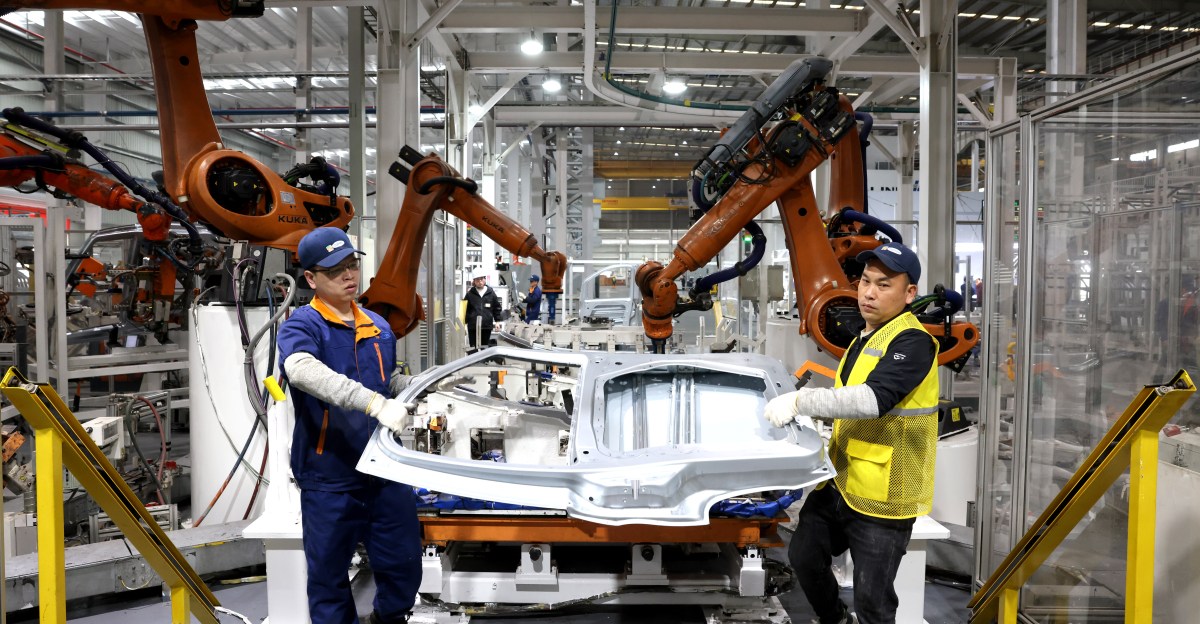
As the United States implements sweeping new tariffs on Chinese goods, Beijing faces a critical juncture that could reshape its economic trajectory. The Biden administration’s recent decision to maintain and expand Trump-era tariffs—including a 100% levy on electric vehicles—forces China to either adapt or risk losing its competitive edge. With $18 billion in targeted imports, this escalation presents both challenges and potential openings for the world’s second-largest economy to pivot its trade strategy.
The Strategic Crossroads for China’s Economy
China’s response to the U.S. tariffs reveals a calculated balancing act. While official statements condemn the measures as “protectionist,” behind closed doors, policymakers appear to be exploring three potential pathways:
- Retaliatory measures: Matching tariffs could further strain relations but satisfy domestic political demands
- Supply chain diversification: Accelerating the “China+1” strategy many manufacturers already employ
- Technological self-sufficiency: Doubling down on semiconductor and green energy independence
Dr. Lin Wei, a trade economist at Peking University, notes: “The tariffs have ironically given Beijing political cover to accelerate reforms they wanted anyway. The Made in China 2025 initiative suddenly looks more prescient than provocative.”
How Tariffs Could Backfire on U.S. Objectives
Initial data suggests the tariffs may be achieving the opposite of their intended effect. Chinese exports to Southeast Asia grew 8.4% year-over-year in Q1 2024, while transshipment through Mexico to the U.S. hit record levels. This “third-party trade” undermines tariff effectiveness while strengthening China’s regional influence.
Key sectors where China could turn the tables:
- EV battery production: China controls 75% of global lithium-ion battery manufacturing capacity
- Rare earth elements: Dominates 90% of processing for magnets crucial in defense and tech
- Solar panel supply chains: Produces 80% of global polysilicon despite U.S. import restrictions
The Domestic Calculus for Chinese Leadership
President Xi Jinping faces competing pressures as the tariffs coincide with China’s economic slowdown. While hardliners advocate for aggressive countermeasures, reformists see an opportunity to address structural weaknesses. The recent 5.3% GDP growth figure—though stronger than expected—masks underlying vulnerabilities in the property sector and local government debt.
“This is ultimately about China’s transition from export-led growth to consumption and innovation,” explains Hong Kong-based analyst Miranda Cheng. “The tariffs accelerate that painful but necessary shift—provided Beijing manages the transition without social instability.”
Emerging Winners in China’s Industrial Policy
Early beneficiaries of the tariff environment include:
- Chinese automakers: BYD and NIO are expanding in Europe and Latin America as U.S. markets close
- Tech startups: Increased government R&D funding for AI and quantum computing
- Domestic tourism: The “revenge travel” boom keeps consumption within China
Investment in semiconductor fabrication plants surged 42% year-over-year, while exports of complete industrial systems (factories built abroad) grew 17%. These trends suggest China is successfully pivoting up the value chain despite trade barriers.
Long-Term Implications for Global Trade
The tariff showdown accelerates the bifurcation of global commerce into competing blocs. China’s recent trade agreements with ASEAN nations and expanded BRICS membership create alternative markets less susceptible to U.S. pressure. Meanwhile, the yuan’s share of global payments hit a record 4.7% in March—still small but growing steadily.
Potential scenarios for the coming decade:
- Best case: Tariffs spur Chinese innovation while avoiding full decoupling
- Base case: Stubborn trade war persists with periodic escalations
- Worst case: Complete supply chain separation triggers global recession
What Comes Next in the U.S.-China Trade War?
As both nations enter election seasons, rhetoric will likely harden while backchannel negotiations continue. China’s next moves may depend on the U.S. political outcome, but its actions suggest preparing for either scenario:
- Stockpiling key commodities like soybeans and crude oil
- Expanding the digital yuan’s cross-border usage
- Cultivating European allies through climate cooperation
The ultimate irony may be that U.S. tariffs—intended to contain China—could instead catalyze its economic transformation. As global businesses reassess supply chains, China’s massive infrastructure, skilled workforce, and integrated ecosystems remain formidable advantages no tariff can erase.
For executives navigating these turbulent trade waters, staying informed about tariff exemptions and alternative markets will be crucial. Subscribe to our trade policy updates for real-time analysis.
See more CCTV News Daily