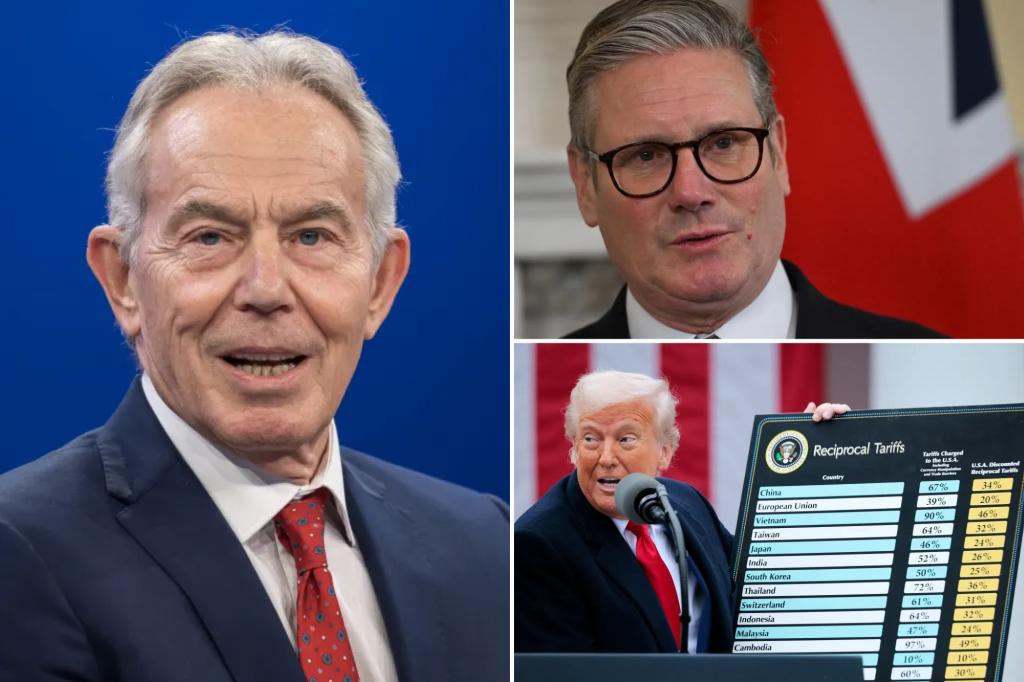
Former British Prime Minister Tony Blair has urged UK leaders to avoid hasty retaliation against potential tariffs imposed by Donald Trump if he wins the 2024 US presidential election. Speaking at a London policy forum yesterday, Blair warned that escalating trade tensions could harm Britain’s fragile economy and damage critical transatlantic relations. His intervention comes as economists predict Trump may levy new tariffs exceeding 10% on European imports, echoing his controversial 2018 trade policies.
The High-Stakes Trade Dilemma
Blair’s address highlighted the complex calculations facing Britain as global trade dynamics shift. “Retaliation might satisfy political pride but would likely backfire economically,” he stated, pointing to the UK’s 17% drop in exports during the 2018-2020 US-China trade war. Current trade between the UK and US totals £279 billion annually, supporting over 1 million jobs.
Key concerns raised include:
- Potential 15% tariffs on UK automotive exports (currently £4.3 billion industry)
- Threats to Scotland’s whisky sector, which sends 33% of production to the US
- Disruptions to pharmaceutical supply chains responsible for 45% of UK medicine imports
Economic Experts Weigh In
Cambridge University trade economist Dr. Sarah Chen supports Blair’s cautious approach: “Our models show reciprocal tariffs could shrink UK GDP by 0.8-1.2% annually. The political symbolism isn’t worth the economic pain.” However, pro-Brexit analysts argue differently. “We didn’t leave the EU to kowtow to American protectionism,” countered Institute of Economic Affairs director Mark Harper.
The debate reflects deeper tensions in post-Brexit Britain’s trade strategy. While the UK seeks a US trade deal, negotiations have stalled since 2020. Blair emphasized that “strategic patience could yield better concessions than public confrontations,” citing his own experience navigating Clinton-era trade disputes.
The Geopolitical Chessboard
Beyond economics, Blair framed the issue as a test of diplomatic maturity. With China watching closely, he warned that “Western unity can’t become collateral damage in trade spats.” His remarks referenced how Beijing exploited previous US-EU tensions to advance its own trade agreements.
Recent history offers sobering lessons:
- EU retaliatory tariffs on US goods in 2018 cost European exporters €6.4 billion
- US soybean farmers lost 82% of their Chinese market during the trade war
- UK steel exports never fully recovered from 2018 tariffs, remaining 23% below pre-tariff levels
Alternative Pathways Forward
Rather than mirroring tariffs, Blair proposed three strategic responses:
- Accelerating trade diversification with Indo-Pacific partners
- Strengthening WTO dispute mechanisms through European allies
- Offering targeted concessions on digital services to gain exemptions
Trade analyst Priya Patel notes this mirrors Japan’s successful 2019 approach: “By negotiating sector-specific deals, Tokyo avoided blanket tariffs while protecting auto exports.” The UK’s stronger services sector (79% of GDP vs EU’s 70%) could provide similar leverage.
The Domestic Political Calculus
Blair’s warning lands as UK parties debate their trade manifestos. Labour faces pressure to promise tough responses, while Conservatives remain divided between free-trade advocates and America-first supporters. “This isn’t about weakness,” Blair stressed. “It’s about recognizing that in trade wars, even winners get wounded.”
Recent polling shows:
- 42% of Britons support retaliatory measures against US tariffs
- 58% prioritize maintaining affordable consumer goods over trade disputes
- Only 31% believe the UK would “win” a tariff confrontation with the US
Looking Beyond the Immediate Crisis
The former PM framed the challenge as part of a broader need for trade strategy reform. He called for modernizing outdated trade rules to address digital economies and climate policies. “The 2020s demand new frameworks, not 1980s-style trade wars,” Blair argued, pointing to the African Continental Free Trade Area as an innovative model.
As global supply chains reconfigure, the UK’s decisions now could determine its economic position for decades. Blair’s cautionary message serves both as warning and opportunity—a chance to craft nuanced responses that protect interests without provoking destructive cycles of retaliation.
Business leaders and policymakers alike should heed these insights as they prepare for potential turbulence ahead. For ongoing analysis of UK-US trade relations, subscribe to our policy briefing series.
See more CCTV News Daily