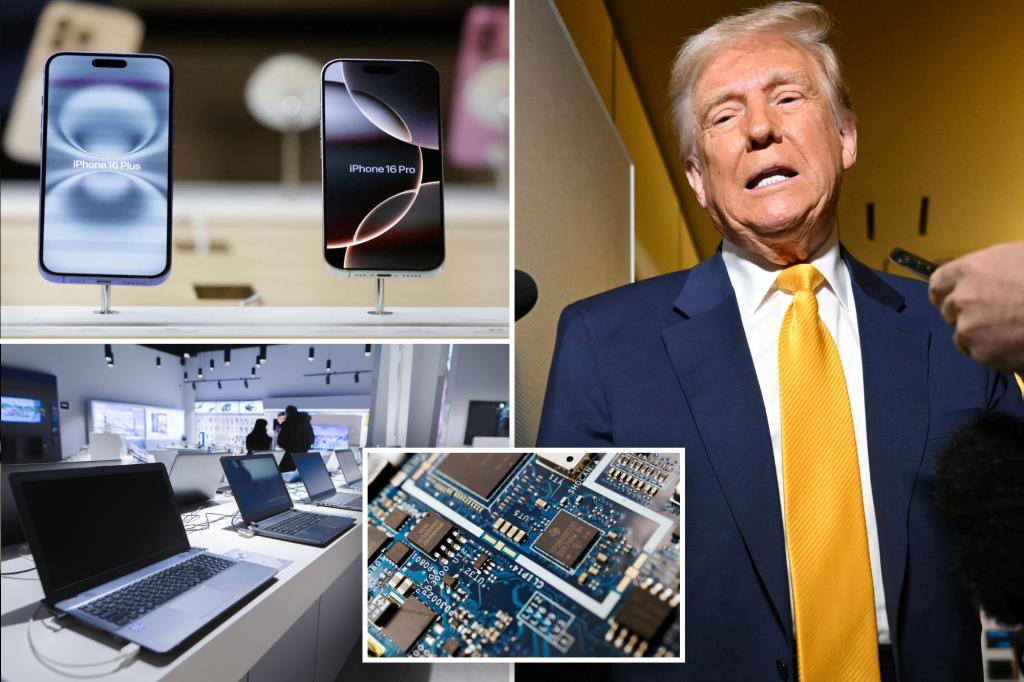
Unpacking Trump’s New Semiconductor Tariffs: Global Tech at a Crossroads
President Donald Trump announced sweeping tariffs on imported semiconductor chips this week, targeting foreign-made electronics in a move that could disrupt global supply chains. Effective immediately, the 15-20% duties apply to chips manufactured outside the U.S., particularly those from China, Taiwan, and South Korea. The administration claims this will boost domestic production, but critics warn of higher consumer prices and retaliatory measures.
The Rationale Behind the Tariffs
The White House framed the decision as a national security imperative. “Semiconductors are the lifeblood of modern technology,” said Commerce Secretary Wilbur Ross in a press briefing. “We cannot rely on geopolitical rivals for components that power everything from smartphones to military systems.” The administration points to declining U.S. market share—from 37% of global production in 1990 to just 12% today—as evidence for intervention.
Key data driving the policy:
- The U.S. imports 80% of its advanced semiconductors, primarily from Asia
- Global chip shortages during the pandemic caused $210 billion in lost auto industry revenue
- China controls 60% of rare earth mineral processing needed for chip manufacturing
Immediate Industry Reactions
Tech giants expressed alarm. “These tariffs will increase production costs by 8-12% across consumer electronics,” said Lisa Su, CEO of Advanced Micro Devices. “That burden ultimately lands on consumers during already inflationary times.” Meanwhile, Intel CEO Pat Gelsinger cautiously endorsed the move: “Strategic protectionism could catalyze the $52 billion in CHIPS Act funding finally reaching American factories.”
The policy exposes divergent corporate strategies:
- Apple reportedly accelerated plans to shift 18% of iPhone production to India
- Samsung froze construction on its $17 billion Texas chip plant pending policy clarity
- Automakers requested exemptions, citing 140,000 vehicles stuck in production due to chip shortages
Global Trade Implications of Semiconductor Tariffs
China’s Commerce Ministry vowed “proportionate countermeasures” within 48 hours, likely targeting U.S. agricultural exports. The EU signaled it might join the dispute, with Trade Commissioner Valdis Dombrovskis warning, “Unilateral actions undermine WTO principles.” Meanwhile, Taiwan and South Korea—which together produce 63% of advanced chips—are negotiating bilateral exemptions.
The Domestic Manufacturing Calculus
While the tariffs aim to reshore production, experts question their efficacy. “Building a single chip fab takes 3-5 years and $10-20 billion,” noted MIT researcher Dr. Erica Fuchs. “Tariffs alone won’t solve America’s skilled labor shortage or infrastructure gaps.” The Semiconductor Industry Association projects U.S. capacity might grow by just 4% annually despite the measures.
Potential bright spots include:
- Texas Instruments’ planned $30 billion expansion in Utah
- New workforce training programs at Arizona State University
- DOE grants for next-gen semiconductor materials research
Consumer Impact and Market Uncertainties
Analysts predict price hikes across electronics categories:
- Smartphones: $50-75 increase for flagship models
- Laptops: 5-8% price jumps by Q4 2023
- Automobiles: $1,200 average added cost for vehicles with advanced driver-assistance systems
However, some economists argue short-term pain could yield long-term gain. “If this reduces dependence on Taiwan by even 10%, it’s worth the tradeoff,” said Hudson Institute senior fellow Thomas Duesterberg. “The Taiwan Strait remains the world’s most dangerous flashpoint.”
Looking Ahead: Policy Alternatives and Outcomes
The tariffs coincide with broader tech decoupling efforts. The U.S. recently expanded export controls on chipmaking equipment to China, while Beijing invested $143 billion in its domestic semiconductor program. Some propose multilateral solutions instead of tariffs, like the proposed “Chip 4” alliance between the U.S., Japan, South Korea, and Taiwan.
Three likely scenarios emerging:
- Escalation: Prolonged trade war slows 5G/AI development globally
- Compromise: Tariffs become targeted with sector-specific exemptions
- Innovation: U.S. achieves breakthroughs in chiplet or quantum computing designs
As the dust settles, businesses must reassess supply chain vulnerabilities. Industry leaders should monitor Treasury Department guidance expected June 15 regarding exemption processes and domestic investment incentives. With geopolitical tensions rising and technology advancing, semiconductor policy will remain a high-stakes balancing act between economic competitiveness and national security.
See more CCTV News Daily