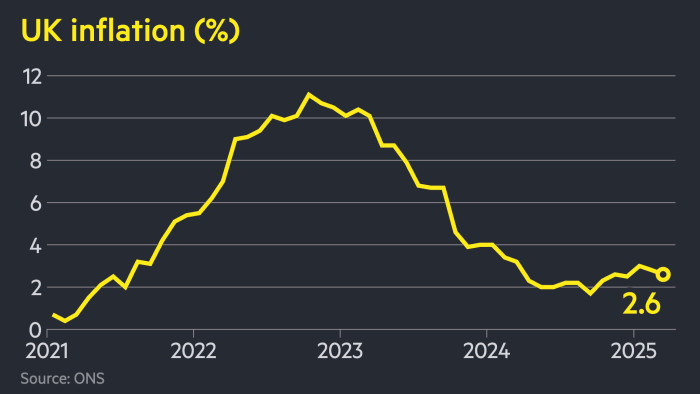
UK Inflation Surprises with Sharp Drop to 2.6%: Economic Implications
In an unexpected development, the UK’s inflation rate fell sharply to 2.6% in March, marking the lowest level in over two years and surpassing economists’ forecasts. The Office for National Statistics (ONS) reported the decline on Wednesday, attributing it to easing energy prices and slower food cost increases. This dramatic drop from February’s 3.4% raises critical questions about the Bank of England’s next moves and potential relief for household budgets.
Breaking Down the Inflation Drop: Key Drivers
The Consumer Prices Index (CPI) data reveals three primary factors behind March’s inflation slowdown:
- Energy price cap reduction: Ofgem’s 12% cut to the household energy cap in April contributed significantly
- Food inflation cooling: Annual food price increases slowed to 4.0% from February’s 5.0%
- Core inflation decline: Stripping out volatile elements, core inflation dropped to 3.5% from 4.2%
“This isn’t just statistical noise—we’re seeing genuine disinflation across multiple sectors,” noted Dr. Sarah Ellington, Chief Economist at the London Institute of Economic Research. “The question now is whether this represents temporary relief or a sustained trend.”
Bank of England’s Dilemma: Rate Cuts on the Horizon?
With inflation now closer to the Bank’s 2% target, pressure mounts for interest rate reductions. Financial markets currently price in:
- 60% chance of a 0.25% cut by August
- Full percentage point reduction expected by end of 2024
However, Monetary Policy Committee member Jonathan Haskel cautioned: “Service sector inflation remains sticky at 5.7%. We need clearer evidence that domestic price pressures are easing before considering rate cuts.”
Consumer Impact: Light at the End of the Tunnel?
For households battered by two years of rising costs, the inflation drop offers tentative relief:
- Average grocery bills now rising £8 monthly vs. £12 last year
- Transport costs down 1.4% annually
- Real wages growing for seventh consecutive month
Manchester teacher Rachel Simmons shared: “Our family budget still feels tight, but seeing prices rise more slowly helps psychologically. We might actually plan a summer holiday this year.”
Business Sector Reactions: Cautious Optimism
Corporate responses to the inflation news have been mixed:
| Sector | Impact |
|---|---|
| Retail | Reports increased footfall but cautious spending |
| Manufacturing | Input costs falling but export challenges remain |
| Services | Wage pressures still squeezing margins |
British Retail Consortium CEO Helen Dickinson observed: “While consumers welcome lower inflation, many retailers remain on a knife-edge between recovering margins and maintaining affordability.”
Global Context: How the UK Compares
The UK’s inflation trajectory now aligns more closely with other major economies:
- Eurozone: 2.4% (March)
- US: 3.5% (March)
- Japan: 2.7% (February)
This convergence reduces one barrier to foreign investment but highlights lingering competitiveness challenges, particularly in services inflation where the UK exceeds peers.
Future Outlook: Risks and Opportunities
Economists identify several factors that could shape inflation’s path:
- Downside risks: Potential energy price shocks, supply chain disruptions
- Upside potential: Stronger-than-expected productivity growth
- Wildcards: General election fiscal promises, global commodity trends
Institute for Fiscal Studies director Paul Johnson warned: “The last mile to 2% may prove toughest. Service sector inflation and wage growth could keep the Bank’s finger hovering over the rate trigger longer than markets expect.”
Strategic Implications for Policymakers and Consumers
As the inflation landscape shifts, strategic considerations emerge:
- For the Bank of England: Balancing growth support against inflation vigilance
- For businesses: Pricing strategies in a lower-inflation environment
- For households: Rebuilding savings after cost-of-living crisis
The coming months will prove crucial in determining whether March’s surprise marks a turning point or temporary respite. Consumers and businesses alike should prepare for multiple scenarios while cautiously welcoming the improved outlook.
For ongoing analysis of how inflation trends affect your finances, subscribe to our economic newsletter for weekly updates and expert insights.
See more CCTV News Daily